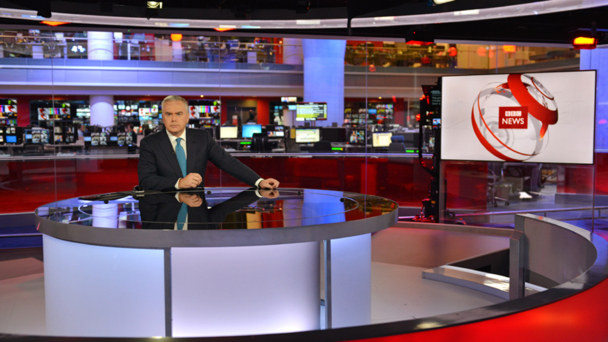
BBC NEWS Studio

Features:
- BBC NEWS 24 Logo, Current Time and Headlines
- BREAKING NEWS (In Caps)
- Scrolling Headlines with Contact information numbers
- 2 Presenters, with scripts and laptops on desk
- News Room in background
- Medium Shot/Long Shot, Centred
BBC NEWS VT

Features:
- BBC NEWS 24 Logo, Current Time and Headlines
- WHALE IN LONDON (In Caps)
- Scrolling Headlines with Contact information numbers
- Shows it is LIVE and the location of where it is taken
- Extra information under Headline
- Shows detailed recordings of what is happening
Using my skills in Paint I made this quick picture of how the layout should look on camera.
Features:
- 2 People sitting on the desk together
- Head lines
- Southend Logo (Might be Copyrighted)
- The Southend regional colours
- Behind the Presenters will be the Newsroom, or in this case the Recording room
In
the final product we will add a clock, scrolling headlines, papers or
laptops on the desk and on the Southend Borough Council Logo we will
have SOUTHESSEX NEWS 24.
CODES AND CONVENTIONS OF TV NEWS AND DOCUMENTARIES
In this blog I am going to explain the codes and conventions of TV news shows and documentaries and analyse examples from the shows and films to comprehensively explain how the conventions are used. A number of conventions used in news and documentary shows are voice-overs, real/live footage, diegetic sound, achieved footage and photographs, interviews with experts, use of text/titles, sound, set-ups, scenery and props. For example in the 18:00 - 18:30 news broadcast on the 26th of March Voice overs are used at the opening titles of the news as they explain about the teacher strike in London, this is so they can give a visual aide as you hear what is going to be on tonight's show, they show achieved footage so that the viewer can also understand what is going to be on the show. Not all of these have to be used in both instances but they are commonly used conventions of news and documentaries.
On Friday 19th of September 1969 the BBC News moved to the Television Centre, this was the birth of many conventions in later years because they had to worry about Colour as well as audio and Real/Live footage now. Below is a picture taken off of Google of the first broadcast from the Television studio, this set up allowed them to use many conventions that were previously unavailable to them. Because the shows target audience is aimed at an average age and just features the news this program is used often by many different people of different ages so they can learn about important aspects of the world.
This shows conventions are...
- Voice Overs
- Real/Live Footage
- Diegetic Audio
- Achieved Footage/Photographs
- Interviews with Experts
- Use of Text/Titles
- Set-Ups
- Scenery
- Clothing
In the BBC news they often use voice overs when showing stock footage of an incident that has occurred in another country or that is hazardous, for example on the 18:00-18:30 news on the 26th of March they explain about the missing plane that has recently been in the headlines, they mention that a new expensive equipment has just arrive and while you see stoke footage of it being unloaded which, as a viewer helped me understand the importance of the equipment. With the budget supplied to them by the BBC they are able to use helicopters and other expensive ways of getting as close as they can to the action, this is not always required because as most of the live footage is taken with a person standing, often with the sky or a relevant piece of scenery behind them, by doing this the also use heavy boom/clip microphones to get the audio which picks up on the diegetic Audio and also when the person speaking is talking one of the reasons they may not digitally remove all diegetic sound is because the viewer may pick up on it and feel as though the audio has been tampered with making the news piece unreliable, for example they interview Roy Daniels, a SSE customer while he sits in his kitchen, the audio is all diegetic with no artificial music over the top.
With the rise of many pocket cameras and social media it is a lot easier to take a picture and send it across the world to be archived so footage submitted can be used in the news if it is from a credible source, this was used a lot during the flooring across England because it was very wide spread and also available for anybody to capture, when showing a clip from a person they but the name of the camera operator/uploaded with scrolling text in the corner of the screen.
Also an important part of the news convention is the scenery and clothing, in other shows like Newsround and CURSE (shown below) the scenery, colour schemes, opening titles and clothing is the first thing the audience will see so in the news show Newsround they wear more casual clothes to appeal to the younger audience it is aimed at, they also use the contrasting colours purple and green to give it a more younger appeal. In CURSE they do the same, it is targeted at a gaming audience estimated at around 13-32 they use titles and imagery show the viewer what the show is about they have also used social networking to get their viewer ship as this is a web only news show the social networking side is important to them.

Convention used in CURSE
- Live footage
- Public Distributed Pictures and Videos
- Voice Overs
- Interviews with Experts
- Use of Text/Titles
- Digital Set-Ups
- Clothing
- Audio
- Social Networking
CURSE is a News Blog made by Gaming fans, it is an important piece to understand because it is made by fans and tailored to how they wants a news show to be made it contains many conventions that people want to have instead of what they need to have, the BBC News needs to be formal and well mannered without voicing any options across, whereas CURSE isn't bound by these same rules and often voices options and views on news pieces in a relaxed manor that is preferred by their target audience, the show regularly has interviews with Experts because it is a fan made news show it is easier to get people on their show via Social Networking or Promotion.

Conventions used in Newsround
- Voice Overs
- Real/Live Footage
- Diegetic Audio
- Achieved Footage/Photographs
- Interviews with Experts
- Use of Text/Titles
- Set-Ups
- Scenery
- Clothing
Amongst all the news videos, almost every single 1 has the presenter standing/sitting within the top-centre third of the shot, they also use many medium shots and don't rely on close up or extreme close ups because these types of shots show emotion which is not a normal convention for a news show, compared to a creative fiction film the shots are more focused on the presenters without showing any emotion between them, they also don't switch between shots often.
Documentary
The codes and conventions of Documentaries are similar to News Shows but are used differently, for example in the Bowling for Columbine staring Michael Moore they use Voice overs, Real/Live footage and Achieved Footage/Photographs but present them in a bias way which shows, in this case, that guns are ultimately bad and will affect those around you if you have them stored in your homes. For example the documentary begins with a number of images of typical things you would expect to see at the start of a normal day such as a postman doing his rounds, a milkman delivering the milk and a farmer in on a tractor. We hear on the voice-over Michael Moore saying 'It was a typical day in America...' and he says that each of these people are going about their day to day business but we then see a shot of a village being bombed and we hear the words 'and the president bombed another town we could not pronounce the name of'. He is using voice-over in an ironic way and trying to get us to realise that this kind of thing is also typical. America is shown to be an aggressive nation using force to make a point. in a field For example Because documentaries are often bias in that they are only showing 1 side of an argument, or if they do show the other side they show it almost as if common option is against them, they are barely used in News Shows and are only mentioned if they are important in current events but are bias.
A selection of Documentaries are, Bowling for Columbine, Louie and the Nazis and Brass eye; Each have their own Codes and Conventions and they all use them differently depending on the situation.

- Voice over
- Real footage of events
- Technicality of realism
- Archive footage/pictures
- Interviews with experts
- Use of text/titles
- Non-Diegetic Sounds
- Diegetic Sounds
In Louie and the Nazis they go around and look for experts in Nazi culture, they find people who openly believe in Nazi beliefs, as they talk to the people they are always on 1 side of their argument but still listen to what they say, for example when they have the mum of the 2 singings kids they corner her in the kitchen to talk to her about Nazis and if she is happy bring her kids up like that, she responds by saying she is very happy for her kids to grow up believing in Nazism but while she defends herself Louie is always on the side saying Nazis are morally wrong. They make voice overs to say things they sometimes can't say in front of the people being interviewed, for example there is a part where Louie talks bout Nazi culture at a festival Louie can't just say he doesn't agree with their beliefs in front of them and of uses voice-overs to get his point across without offending anybody. Archived footage is used in Bowling for Columbine when they show news reels of gun uses and accidents, under the head of those that are being interviewed is the name of the person so it is easier to identify them and they expertise. The use of diegetic and non-diegetic sounds can be used to either show the topic in a different light, for example in 'Supersized me' they used childish music to make the topic sound more light-hearted, but in Louie and the Nazis they don't have any non-diegetic music and focus on the diegetic which could be as a way to say "these people are real and this is not made up."

No comments:
Post a Comment